


MAVCP – Multipath Autonomous Vehicle Control Protocol
Adax Inc
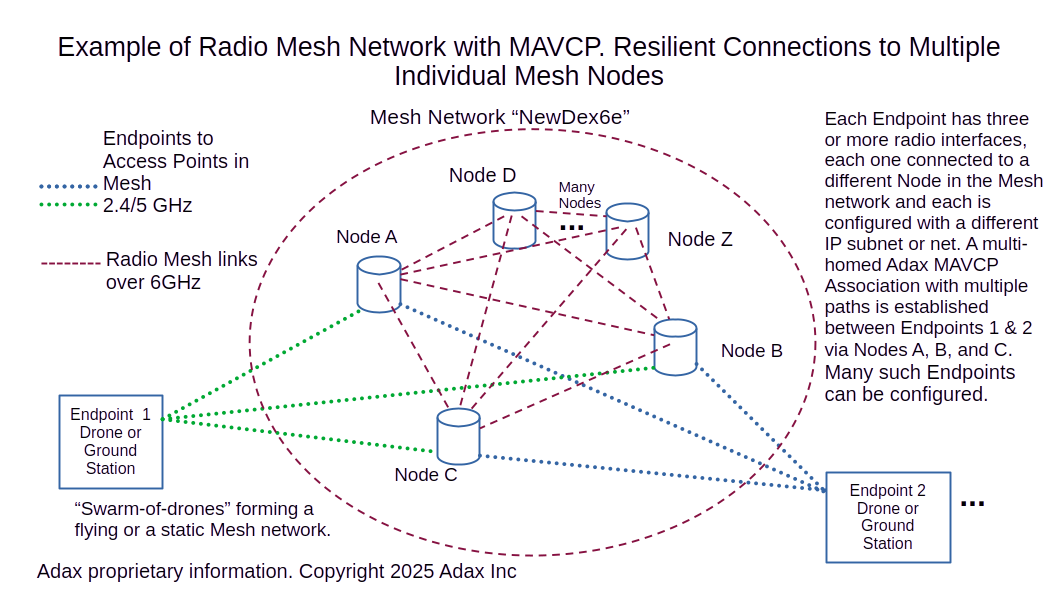
Overview (see figure below)
The failure of drone missions in hostile environments is an urgent problem. Do you know why they are failing? Wouldn’t you like to know why they failed or when they succeeded? You need a solution; so why don’t you have one? Why don’t you assess your outcomes and improve your results? It may be hard to do but you should still do it. Adax MAVCP can make it possible. Drones and interceptors are mostly being shot down (90%) or jammed and missing their targets because their communications systems are very vulnerable to attack and counter-measures.
One source of losses is excessive transmissions by drones. These radio signals are readily detected by adversaries and are used to track and destroy them. They are easily jammed so they this miss their target and there is no way to get reports of success of failure back to the controller. MAVCP is an innovative control and communications protocol that addresses these problems and greatly enhances drone survival and success in highly contested, counter-measures-laden environments. MAVCP (Multipath Autonomous Vehicle Control Protocol) operates seamlessly over any IP-based network, including relay drones, satellites, and hybrid radio layers ensuring operational continuity where traditional solutions fail. Because of its rapid recovery of lost packets, it maintains the “chain of custody”, video fidelity, images, and telemetry streams in spite of 30% continuous destructive packet loss. No other available product can do this. MAVCP can save your drones from early destruction.
Whether traveling in total silence, sending a few images, or using video, in
any case, in the last few moments you need confirmation that you have hit the
target, using spare and lean communications. And if you miss, you need to know
why so you can adjust your strategy. Existing video signals can be rendered
useless by 3-5% packet loss from jamming. MAVCP can deliver very usable video
with 30% packet loss because it successfully corrects the lost packets in real
time. If instead of video, target confirmation is done with photo images every
few seconds or data telemetry, the signal can be jammed and the controller
cannot confirm the target or verify success. Here again MAVCP will get through.
As you close in on the target, these are the most critical moments when the
controller needs the information but the jamming will be at its worst. Even a
few seconds of communication disruption can lead to mission failure. MAVCP can
overcome the jamming and assure mission success.
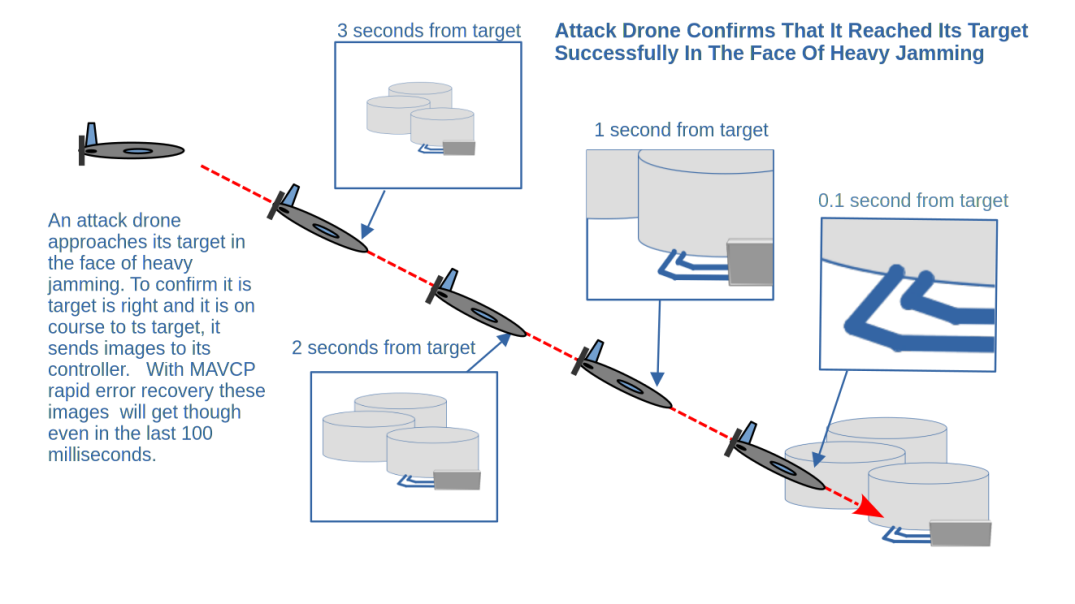
Critically important, in the last few seconds before reaching the target, MAVCP can in real-time, reliably return images or data telemetry, such as GPS or ground sensing information. Consider a sequence of images taken at 3, 2, 1, and 0.1 seconds from the target. Even with 30% packet loss from jamming, with MAVCP there is a 99.7% probability that all four images will arrive at the controller in real-time. This means the controller can confirm that the target is the correct one and if not, take action to abort the mission and avoid attacks on unintended targets. And when reliably receiving an image or telemetry in the last 0.1 second, you will have high confidence that the target has been hit. Other communication methods only have a 10%-20% probability of delivering all four images or telemetry packets in real-time to the controller. With results confirmed by MAVCP, you won’t need to send a second drone to finish the job.
Without MAVCP your chances of confirming your mission results are low. We can greatly improve these results and confirm success of your missions by providing telemetry and photo evidence of outcome in the last seconds, leading to analysis that improves future results. With this improved “end of mission” evidence, you can ascertain mission success and better identify and address the causes of mission failures. There is nothing else like this product in the current drone command and control space, and it is superior to all existing deployed solutions in hostile environments according to military and industry drone experts.
The next two figures show how MAVCP can help in the last moments. The an attack drone is returning images when it is a few seconds away from the target. Even in the last 0.1 second MAVCP can error correct quickly enough that the controller receives the image in spite of massive jamming.
The second figure shows a drone interceptor shooting down a hostile drone. Both interceptor and drone are moving so the controller must receive the images quickly in real-time while it is being jammed.
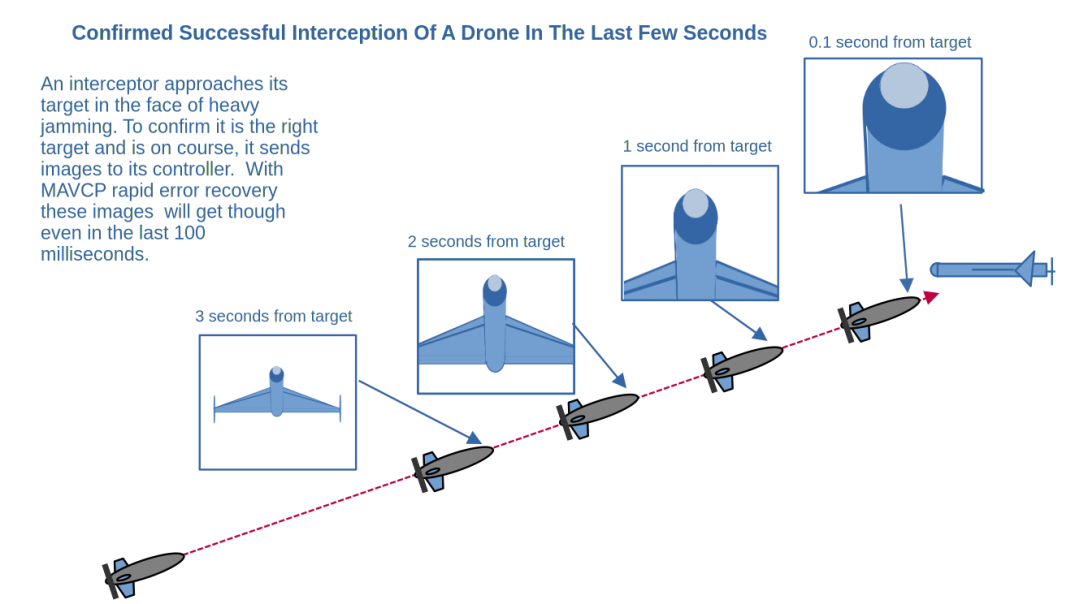
In both cases the controller must receive all the images and without delay. MAVCP can do that!
MAVCP has faster and more robust adaptation to node failures and jammed radio link counter-measures than other solutions which in “peak-engagement” (last mile) environments helps survival in swarms-of-drones. MAVCP can be easily integrated into existing vendor’s software for drone control. The problems of networks broadcasting too much and the resulting drone losses are well known. Our solution transparently works through the network and can work with any IP network implementation and encryption stack. With MAVCP you can complete your mission while facing serious attacks and counter-measures.
Why has Adax found a solution and others haven’t?
Adax has a been a provider of robust, highly reliable communication protocols for decades. Our products have kept critical networks up and running in the face of fire, floods, earthquakes, hurricanes, bombings and sabotage all over the world. They have been deployed in military systems. We brought this expertise and insight to the development of MAVCP. Other protocols do not match its features. For example, widely-used implementations of SCTP has some of the features but cannot meet MAVCP’s performance, scalability, and packet-loss response in the face of heavy packet loss and errors such as from jamming or relay node destruction. It was really designed for a different and less adversarial environment.
Advantages of MAVCP:
1. MAVCP is a transport protocol derived from Adax real-time protocols with new features and capabilities aimed at protecting drone communications and mesh or 2-band network operations in hostile environments, such as situations where active counter-measures are jamming or destroying drones and nodes in mesh networks. Flying and static mesh networks put great strain on conventional network applications. They require an improved and superior transport method to overcome these new challenges and demands. Without an improved transport layer, mesh or 2-band radio networks will fail to provide real-time data delivery and fail in their mission. Easily integrated, this solution fits between your existing application and the transport layer/radio.
2. Adax real-time protocols were developed for the demanding requirements of Telecommunication networks which require redundancy, high-reliability, rapid error recovery, and real-time performance. These qualities are expanded and carried over into Adax MAVCP.
3. Multiple independent paths through the mesh network provide greater redundancy and resilience from attack.
4. Automatic AI-evaluation of the link quality of all paths with automatic, real-time selection of a new primary data path before the existing one fails.
5. AI Stealth modes increase drone safety and can reduce radio footprint to near zero.
6. Best in class for lost or dropped packet response. Errors can be detected and corrected in 10 ms or less with fewer re-transmissions of lost packets.
7. Because of the careful control of re-transmitted packets there are fewer radio transmissions to give away a drone’s location. Less radio chatter – better stealth. This means better survival for drones connected to the mesh network.
8. Faster and more robust adaptation to node failure or mesh destruction.
9. Better mission continuity under node failure. Even with 50%-90% mesh node losses with MAVCP you can complete the mission.
10. A uniform and high-performance transport protocol simplifies and reduces your total system costs
11. Best for stealth, best in class for “peak-engagement” (last mile) conditions where there is the highest rate of mesh node loss or jamming. MAVCP survives multiple mesh node jamming or losses while maintaining real-time performance.
MAVCP is ideal for flying or static Mesh networks as used by a swarm-of-drones. Even when losing nodes from the mesh, the end-to-end communication is uninterrupted.
Dynamic Path Management
As drones or vehicles move, they move away from the ground stations or mesh network nodes to which they are currently connected. MAVCP can add new IP paths and delete obsolete paths as the drone flies. This maintains redundant links and by removing old ones reduces radio transmissions.
Secure Authentication with Performance & Visibility
Security in the network is more important today than ever before. Wireless networks are particularly open to interception and interference by adversaries. Networks are subject to attacks with greater frequency and potential damage is a constant threat. This problem only increases as more devices are connected to the network.
MAVCP and DTLS
Adax MAVCP and DTLS together provide payload encryption so user data is protected from prying eyes. The Datagram Transport Layer Security (DTLS), RFC 9147, provides encryption of the payload in message-oriented protocols like MAVCP. It supports the latest in encryption algorithms to safeguard user’s data.
Quality and Reliability of Service
Built to meet the exacting demands of 5G, IoT and M2M, Adax MAVCP provides the signaling reliability to enable service providers to ensure the delivery of valuable and timely data for real-time applications with a low tolerance of latency, by implementing signaling protocols and services that:
• Perform vigilant in-service quality monitoring of the signaling links
• Detect degradation of link quality at very short, programmable intervals and take action to move to alternative links before the primary link goes out of service
• Provide redundancy via an enhanced version of multi-homing Adax MAVCP constantly monitors the primary and alternative links to ensure faster lost packet recovery in both single or multi-homing situations and pro-actively starts to repair and correct lost packet after one minimum Retransmission Timeout interval as short as 20 ms. This is industry-leading performance.
Why Adax MAVCP?
No other drone control solutions includes all of these features and options, enabling Adax MAVCP to deliver the highest levels of performance and service that:
• Do you want your drones to succeed or be shot down before they complete their mission?
• Provides both redundancy and fault tolerance for drone control applications avoiding single points of network failure
• Transparently switching paths while under attack to an alternate path, without packet loss or application layer intervention.
• Improves destination and peer path failure detection
• Rapid and simplified application development and deployment by preservation of message boundaries, ordered and optionally unordered delivery of MAVCP user messages, and support for large numbers of unidirectional and bidirectional streams (good for video and surveillance).
• DTLS tuned with Adax MAVCP provides fast, real-time, encryption performance. DTLS over MAVCP gives 2-to-5 times better real-time response than UDP
• Adax libraries provide a simple framework for applications to interface directly to DTLS and take full advantage of the underlying MAVCP features
Sample Applications that require the advantages of Adax MAVCP
Applications with high-throughput and low-latency requirements include:
• Vehicle control, telematics and updates
• Video surveillance
• Location tracking
Applications with a low tolerance of errors and latency include:
• Drone positioning and location.
• Augmented and Virtual Reality
• Industrial robotics and environmental control
Adax Inc
2900 Lakeshore Ave,
Oakland, CA 94610, USA
Contact: sales@adax.com
Tel: (510) 548 7047
Web: https://www.adax.com